The Hard Water Tax
There is a hidden tax to living in Dorset, Wiltshire and Hampshire. It is invisible, compounding and entirely preventable! It is a hard water tax.
Our stunning coastlines are thanks to the geology of Dorset. The chalk and limestone that can often leave us saying ‘look at that view’ are the culprits of the hard water we put up with. When rainwater falls, it passes through the rocks, picking up both calcium and magnesium ions which makes it hard. When that water is heated it causes limescale in your home.
Today we are talking about the invisible impacts of limescale, and the consequences for your back pocket.
So, What Is the Cost of Hard Water?
There are predominantly 4 ways that hard water costs you money:
1. Energy efficiency
2. Cleaning products
3. Appliance lifespan
4. Repairs and Plumbing maintenance
1. Energy Efficiency
As limescale builds up in your boiler, pipes and radiators – your boiler must work harder. Think of it like a clogged arteries in the body. When trying to get through a smaller gap, the heart must work harder to pump blood round the body. The same is true of your boiler, it must heat an extra layer, the limescale, before it can have any impact on warming your home/water.
Two trusted sources make claims about the impact limescale has on energy efficiency:
– British Water (the trade association for the UK water industry) claims 1.6mm of scale = 12% efficiency loss www.britishwater.co.uk
– The Carbon Trust claim – 1mm of scale = 7% increase in energy input Document CTV008
Industry sources state that in a household of 4 people, over the course of a year 70kg of limescale can build up. This seems shocking, however what does it really mean? British Water helps to translate this into something more meaningful. They believe, in an area with 300PPM water hardness the scale builds up at approximately 1mm / year Combimate. The ‘heart’ of your home heating system!
If we put all these assumptions together, we can build a picture of the cost over a few years.
– Household of 4 gas bill: £950 / year for gas – assumes 13,600KW Ofgem Average Usage
– Water hardness: 300PPM (average in Dorset)
– Scale build up rate: 1mm / year
– Efficiency loss: 7% / 1mm
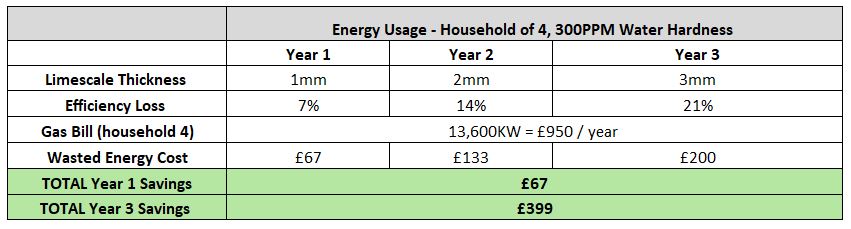
In the case of heating efficiency, this cost compounds over the years with the millimetres of limescale built up. An estimate of 13,600KW/year costs £950 for a household of 4. This table shows how cumulatively this household’s ‘hard water tax’ would be £399 by the end of year 3.
A big assumption here is that you are starting from Year 1, ie you have a new build. If you have a moved into a property which has accumulated years of limescale damage your starting point may be many mm of limescale.
So, what can you do about this damage? It is possible to reverse this damage, we will explain how later on.
2. Cleaning Products
To be able to explain the small everyday impacts hard water has on cleaning products we have gone into quite granular detail, so please bear with us!
We have looked at 3 separate drivers of increased cost related to cleaning products:
a) Descaling products
b) Detergent use
c) Toiletries use
Independent studies conducted by Water Quality Research Foundation (WQRF) in the US found that ‘consumers can cut back on laundry detergent use by up to 50% when using softened water instead of hard water’.
50% less laundry detergent seems to be quite well regarded across the industry. There are even claims of 75% less by Culligan Harvey’s in the UK. We have done some calculations based on the most conservative figure of 50% less of the product required when using with softened water. For this exercise we have assumed the use of leading brands in the UK for each category.
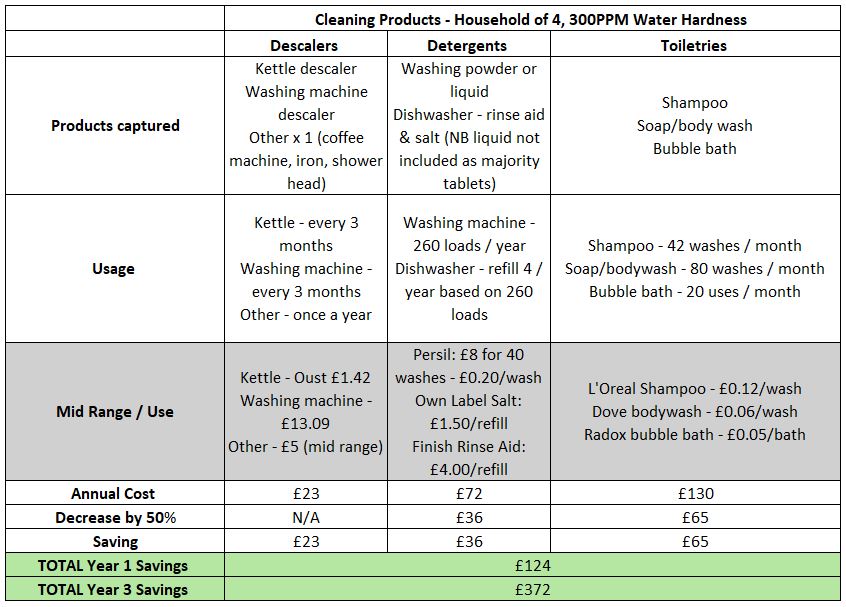
You may be thinking, “we do WAAY more loads of washing than that” (I know I was), “every three months?! More like every week we are descaling the kettle” or “we don’t use our bath at all”. Capturing every individual household’s usage is a challenge but this, conservative estimate, shows how the likely, unconscious increased use of product or use of descalers can add up each year.
3. Appliance Lifespan
The impacts of hard water and limescale is most visible in your kettle.
There are so many appliances in your home which may be affected by limescale from kettles, coffee machines, Quooker taps, steam irons and electric showers through to significant luxury items such Jacuzzis or heated pools. The list is extensive.
In this section we have chosen to focus on the three big ticket items, most likely to be present in all households. Your washing machine, dishwasher and boiler.
The most widely accepted industry data based on WQA research suggests the impacts of hard water and limescale cause “30-50% lifespan reduction” Culligan, the higher end of this spectrum is most likely to be relevant in your heating system.
We have used the best-selling brand in the UK of each to be able to calculate lifespan data, but we have factored in a more conservative price – assuming you shop around and get yourself a good Black Friday deal.
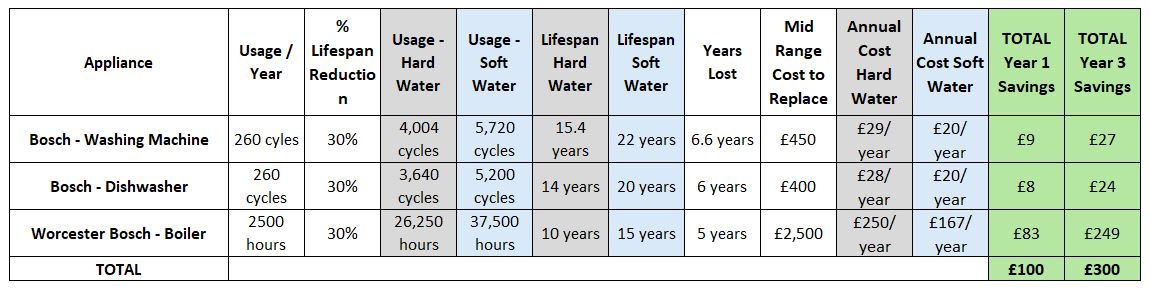
It is quite well documented that hard water is likely to reduce the lifespan of your boiler by 50%, however having looked at specific manufacturer data most boilers come with a 10-year warranty, so we have kept this to 30% for each appliance to give an accurate picture of costs. You can see here that annual costs for the three most common appliances are £100.
It’s starting to add up, one last cost to take you through.
4. Repairs & Plumbing Maintenance
We will be honest; this one is a little harder to put some numbers to. There are a few things that we could capture in repairs and plumbing maintenance. The most common are replacement taps, showers, servicing to clean limescale, and boiler repair.
The Boiler Guide did a study in 2020 which found correlation between hardness of the water and frequency of boiler repair call outs. The difference doesn’t seem huge, but if you apply this across all equipment and appliances in your home, it starts to add up.
UK Average Costs for the following:

It feels reasonable to assume here a £25 per year addition in costs to your home due to hard water. We recognise this to not be so well founded as our other three sections, but we do not want this to go unquantified.
When you think back to your last 5 years spend on home maintenance, have you incurred any of these costs? Or have you been looking at your taps and thinking, you are going to have to tackle them soon because of limescale and worrying about the costs?
Hard Water Tax – What Can I Do? / How Do I Make My Water Soft?
So, when we add it up over time. Our conservative estimate in three years would be that you would be looking at a hard water tax of over £1000.
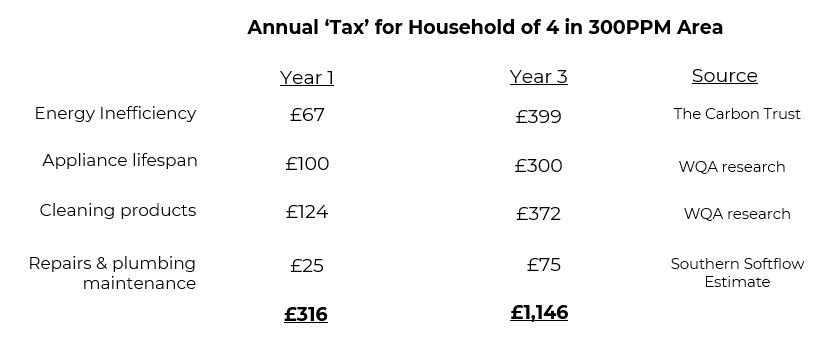
You’ll be pleased to hear though; this hard water tax is entirely preventable!
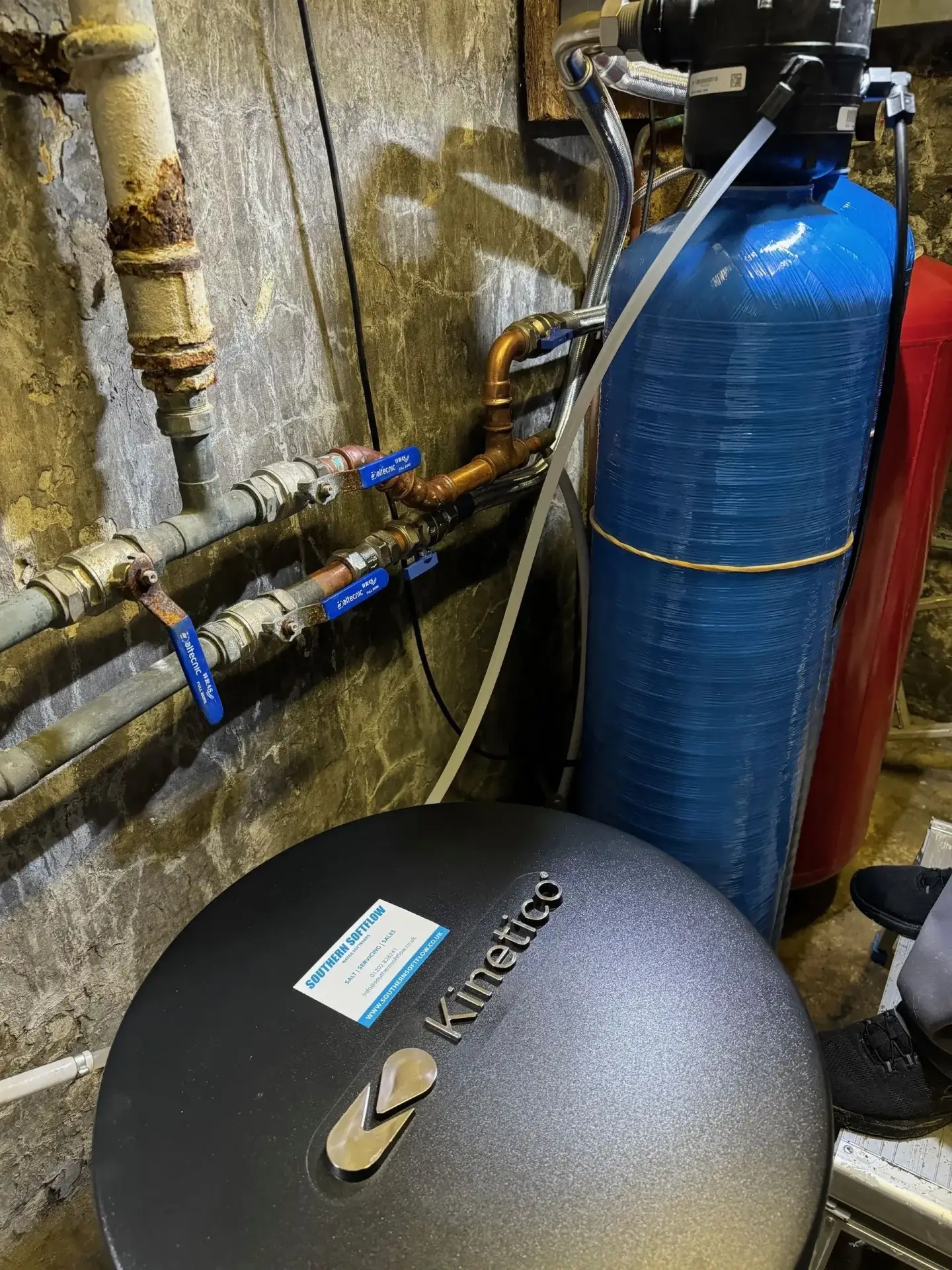
Fitting a water softener, at the source of where your water enters your home is the most well regarded and comprehensive way to deal with limescale. By doing so you take your water hardness to 0.
For anyone thinking, “well I have been living in this house for 10 years already, the damage is already done”, we have some good news. Fitting a water softener can, over time, reverse limescale damage and build up. A softener gets rid of the visible limescale you see on taps, shower screens and kettles and helps to reduce dryness on your skin and hair. It can even alleviate symptoms of Eczema or Psoriasis.
If you would like to find out more about water softeners and how to save yourself £1000s in hard water tax, book a no-obligation home survey on 01202 828 241.
We are Southern Softflow, a family-run independent business based on Wimborne who pride ourselves in offering straightforward, honest advice.